Operationalizing AI-Powered RCSA with SysRisk and AIRA

Operationalizing AI-Powered RCSA with SysRisk and AIRA

From Static RCSA to Continuous Risk Intelligence
www.sysonex.com

Table of Contents

Executive Summary

Risk Control Self-Assessment (RCSA) remains one of the most widely adopted yet consistently challenged practices within Enterprise Risk Management (ERM). While an estimated 70–75% of organizations globally perform RCSA in some form, many continue to struggle with its execution, relevance, and strategic value. Traditional RCSA approaches are often manual, episodic, and backward-looking—delivering insights only after substantial effort, time, and organizational fatigue.
As enterprises face accelerating regulatory scrutiny, operational complexity, third-party dependency, and digital risk exposure, static RCSA models are no longer sufficient. Boards and executive leadership increasingly require real-time visibility into operational risk, control effectiveness, and alignment with strategic objectives.
This whitepaper examines why conventional RCSA models fail to scale in modern enterprises and presents a practical, technology-driven alternative. It introduces SysRisk and its AI Risk Assistant, AIRA, as an integrated operating model that transforms RCSA from a periodic compliance exercise into a continuous, intelligence-driven risk capability.

Introduction: The RCSA Paradox

RCSA occupies a unique and often contradictory position within risk management programs. On one hand, it is regarded as essential for identifying operational risks, validating control effectiveness, and supporting regulatory compliance. On the other, it is frequently cited by risk leaders as one of the most resource-intensive, time-consuming, and least valued activities within the risk lifecycle.
Despite its intent, traditional RCSA frequently produces outputs that are outdated by the time they reach senior management or the board. Risk environments evolve faster than assessment cycles, leaving organizations reliant on historical snapshots rather than current risk intelligence.
This paradox—high adoption coupled with persistent dissatisfaction—signals a structural problem, not an executional one.

Why Traditional RCSA Struggles at Scale

Discrete and Expanding Risk Exposure

Modern organizations operate across complex operational, digital, regulatory, and third-party ecosystems. Even mid-sized enterprises can accumulate hundreds or thousands of discrete operational risks across projects, processes, and business units.

Information Overload and Reporting Latency

Traditional RCSA programs generate significant volumes of documentation, workshops, and reports. However, by the time assessments are consolidated and approved, the underlying risks may no longer reflect current operating conditions. This delay erodes executive confidence and reduces engagement.

Process Mapping Limitations

Process-driven RCSA approaches rely heavily on detailed process maps. In practice, processes evolve continuously, informal workflows emerge, and shadow processes remain undocumented. Maintaining accurate process inventories becomes both costly and unsustainable.

Top-Down vs Bottom-Up Tension

Organizations often struggle to balance strategic, board driven risk perspectives with frontline operational realities. Top-down assessments risk abstraction, while bottom-up approaches can overwhelm leadership with excessive detail. Without a unifying framework, alignment remains elusive.

Workshop Fatigue and Executive Disengagement

RCSA workshops require extensive coordination, subject matter expertise, and executive sponsorship. Over time, fatigue sets in, participation declines, and the perceived value diminishes—further weakening outcomes.

The Shift to Continuous Risk Intelligence

Leading organizations are rethinking RCSA not as a discrete annual event, but as a continuous capability embedded within daily operations. This shift is driven by several imperatives:
  • Real-time risk visibility
  • Ongoing control validation
  • Dynamic alignment with strategy and risk appetite
  • Faster decision cycles

Continuous risk intelligence replaces static documentation with living risk registers, automated workflows, and analytics-driven
insight.

SysRisk and AIRA : An Integrated RCSA Operating Model

SysRisk provides a unified enterprise platform for operational risk management, while AIRA functions as its embedded intelligence layer. Together, they operationalize RCSA across its full lifecycle:
  • Risk Identification and Documentation: Risks are captured directly within the system, assigned ownership, and routed through structured approval workflows.
  • Risk Assessment and Prioritization: Likelihood, impact, and cost dimensions are assessed dynamically, enabling continuous reprioritization.
  • Control Definition and Implementation: Controls are linked directly to risks, with visibility into implementation status and effectiveness.
  • Control Testing and Monitoring: Ongoing testing replaces point-in-time validation.
  • Issue Identification and Corrective Action: Root causes, remediation actions, and timelines are tracked in real time.
AIRA enhances each stage by supporting pattern recognition, control recommendations, root cause analysis, and natural-language risk queries, without removing human accountability

Data, Analytics, and Visualization

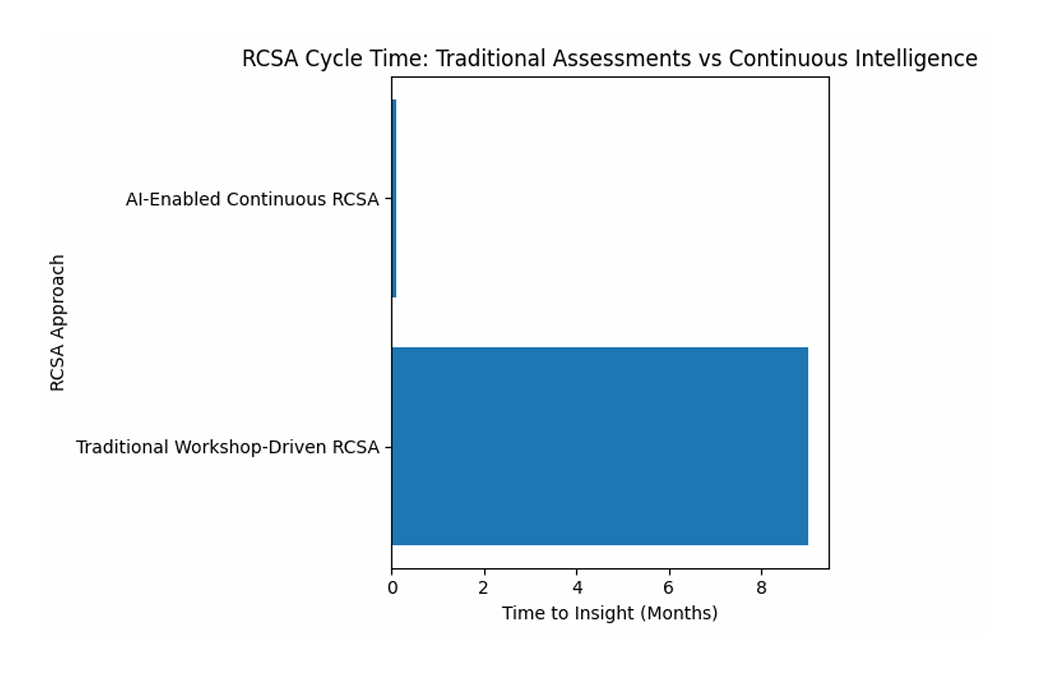
RCSA Cycle Time - Manual vs AI-Enabled

Data Assumptions:
  • Traditional, workshop-driven RCSA cycles typically require 6–12 months to complete end-to-end, including validation and reporting.
  • AI-enabled RCSA operating models deliver near real-time visibility, with continuous updates rather than fixed assessment windows.
Board Insight: Highlights the structural latency of traditional RCSA and frames time-to-insight as a risk in itself.

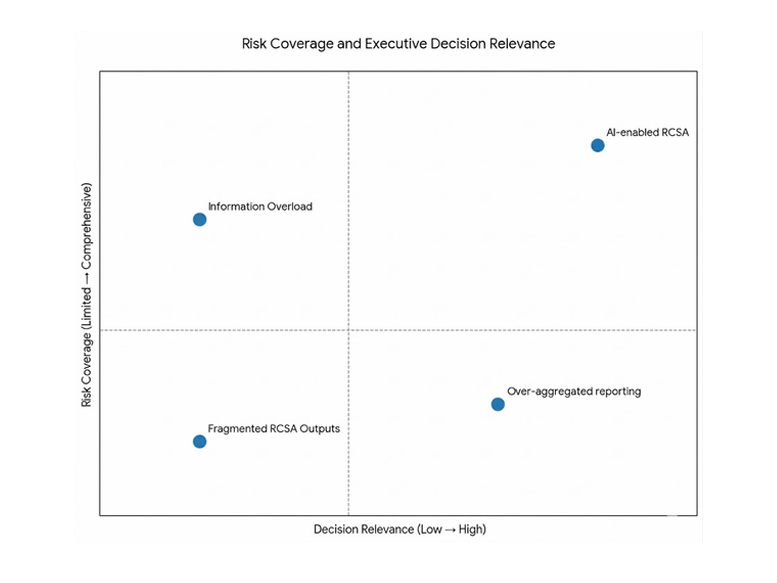
Risk Coverage vs Decision Relevance

Board Insight: Highlights the structural latency of traditional RCSA and frames time-to-insight as a material risk in itself.

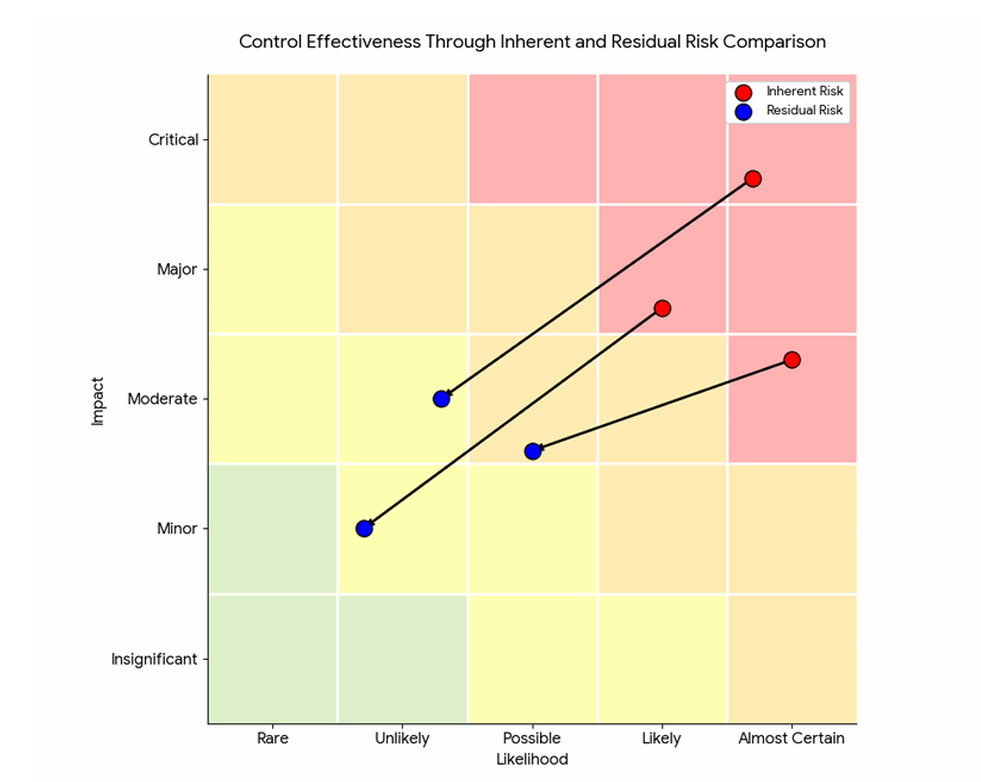
Inherent vs Residual Risk Heat Map

Data Assumptions:
  • Inherent risk plotted prior to control application.
  • Residual risk plotted post-control implementation.
Board Insight: Makes control effectiveness visible and auditable, shifting conversations from anecdotal assurance to evidence based oversight.

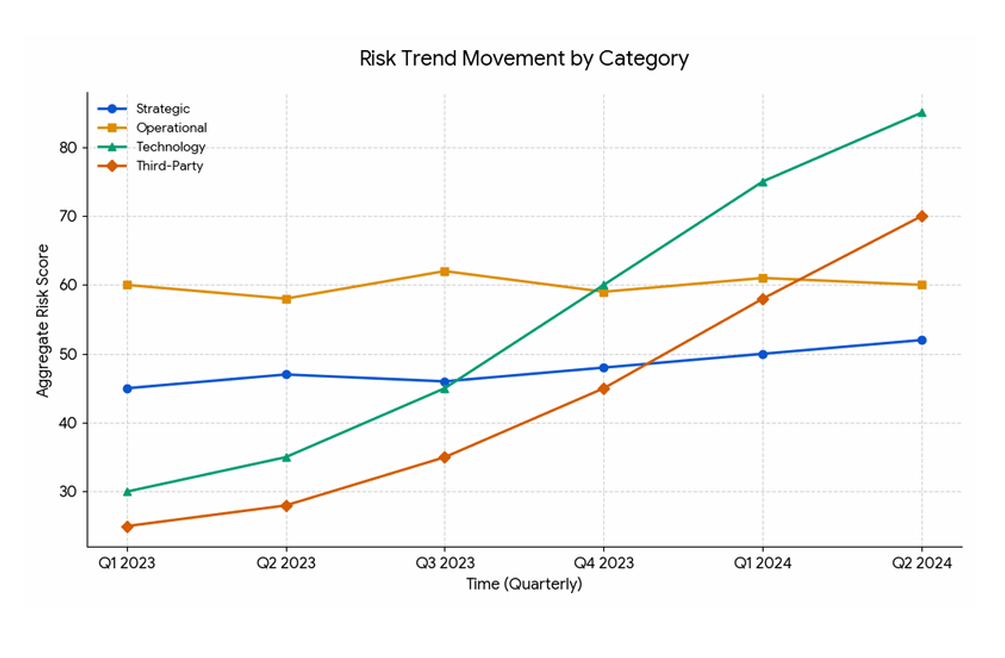
Risk Trend Trajectory Over Time

Data Assumptions:
  • Tracks movement of strategic, operational, technology, and third-party risks
  • Highlights emerging risk acceleration rather than static exposure
Board Insight: Enables forward-looking governance by identifying momentum, not just magnitude, of risk exposure.
These visualizations executive views. support board-level oversight while preserving operational granularity beneat.

Governance, Accountability, and Board Oversight

For boards and executive leadership, the central question is no longer whether RCSA is performed, but whether it produces decision-grade intelligence. Traditional RCSA models rely on periodic attestation, offering comfort without continuity.
SysRisk reframes governance by embedding RCSA directly into enterprise operations, enabling boards to move from retrospective assurance to continuous oversight. Risk appetite, tolerance thresholds, and strategic objectives are not reviewed annually—they are monitored in real time.
This shift strengthens accountability across the Three Lines Model, reduces reliance on manual certification, and materially improves audit defensibility in highly regulated environments.
Effective RCSA must reinforce governance, not burden it. SysRisk aligns RCSA with:
  • Board-approved risk appetite
  • Three Lines Model accountability
  • Audit and regulatory expectations
Executives and boards gain continuous assurance rather than episodic sign-off, strengthening confidence and defensibility.

The Role of Artificial Intelligence in RCSA

Artificial intelligence is often mischaracterized as a replacement for professional judgment. In risk management, this framing is not only inaccurate—it is dangerous. AIRA is deliberately positioned as a decision-support capability, designed to augment expertise, not override it.
Within SysRisk, AIRA enables:
  • Pattern recognition across large and complex risk datasets
  • Context-aware control recommendations
  • Accelerated root cause analysis
  • Continuous mapping of risk to strategy and objectives
  • Natural-language interrogation of risk registers and control environments
For executives and boards, the value lies not in automation for its own sake, but in consistency, speed, and clarity— attributes that materially improve risk-informed decision making.
AIRA is designed as a decision-support capability, not a decision-maker. Its role includes:
  • Identifying risk patterns across large datasets
  • Recommending relevant controls and mitigation actions
  • Supporting root cause analysis
  • Mapping risks to strategic objectives
  • Enabling natural-language interaction with risk data
This approach enhances human judgment rather than replacing it.

Business Outcomes and Measurable Impact

Organizations adopting AI-enabled RCSA models report:

  • Faster assessment cycles
  • Improved risk coverage and relevance
  • Higher executive and board engagement
  • Stronger regulatory confidence
  • Reduced operational blind spots
Most importantly, RCSA evolves from a compliance obligation into a value-generating management capability.

Conclusion

RCSA, when treated as a periodic and manual exercise, offers diminishing returns in a world defined by velocity, complexity, and interdependence. The cost is not merely inefficiency—it is strategic blind spots at precisely the moment organizations can least afford them.
By operationalizing RCSA as a continuous, intelligence-driven capability, organizations shift from reactive compliance to proactive governance. SysRisk provides the structural foundation for this shift, while AIRA delivers the analytical depth and responsiveness required at enterprise scale.
For boards and executive leadership, this represents a fundamental redefinition of assurance—one grounded not in annual certification, but in continuous confidence.
Ready to elevate RCSA from periodic assessment to continuous risk intelligence?
SysRisk provides the enterprise platform for structured RCSA, while AIRA unlocks deeper insight through AI-driven analysis and real-time visibility.

Related Articles

Want to learn more about our ideas and thought leadership, please read the following. If there are any areas of interest from your organization, please feel free to reach out to us. 

Sysonex, Risk Management