AI-Driven Risk Intelligence for Board Executives

AI-Driven Risk Intelligence for Board Executives

Driving Intelligent Governance, Real-Time Risk Visibility, and Confident Board Decisions

www.sysonex.com

Sysonex, Risk Management

Table of Contents

Executive Summary

Artificial Intelligence is rapidly transforming enterprise decisionmaking, risk exposure, and governance expectations. However, while adoption accelerates, board-level readiness remains critically behind. Only 39% of Fortune 100 boards have formal AI oversight mechanisms. Meanwhile, 95% of executives report experiencing AIrelated incidents or failures.
This disconnect creates a growing governance gap — where AIdriven opportunities expand, but board-level visibility, control, and accountability lag behind. AI-driven risk management for board executives is not about operational efficiency. It is about strategic oversight, enterprise resilience, and decision intelligence.

88%

Organizations using AI in at least one function

↑ Sharply from 2023

74%

Cite AI inaccuracy as a
major enterprise risk

↑ Growing Concern

25%

Have fully implemented
AI governance
frameworks

↓ Governance Gap

$250 B+

Cite AI inaccuracy as a
major enterprise risk

↑ Accelarating

The Boardroom Imperative in the AI Era

1.1 AI is Now a Board-Level Risk
AI is no longer an IT issue — it is a strategic governance issue.
88%
of risk leaders expect AI to be central to risk strategy by 2025

NSSG GLOBAL, 2025

90%
of companies lack formal AI governance frameworks

TRUST.ORG AICDI,
2025

$4.4B
in enterprise losses from AI bias, compliance failures, and system errors

Reuters / EY, 2025

88%
of risk leaders expect AI to be central to risk strategy by 2025

NSSG Global, 2025

Artificial Intelligence is no longer just a technology initiative—it is a strategic governance priority. As AI becomes increasingly embedded in business operations and decision-making, boards must oversee its risks and opportunities with the same rigor as financial, operational, and regulatory matters. While 70% of risk leaders expect AI to be central to enterprise risk strategy, nearly 90% of organizations still lack formal AI governance frameworks, creating a significant gap between AI adoption and effective oversight.
Board Reality
Boards are responsible for guiding strategy, overseeing risk, ensuring regulatory compliance, and upholding ethical standards. As AI increasingly influences business decisions, operations, and customer interactions, it directly affects each of these responsibilities. Effective AI governance is therefore essential to ensure innovation is aligned with organizational objectives, regulatory expectations, and stakeholder trust.
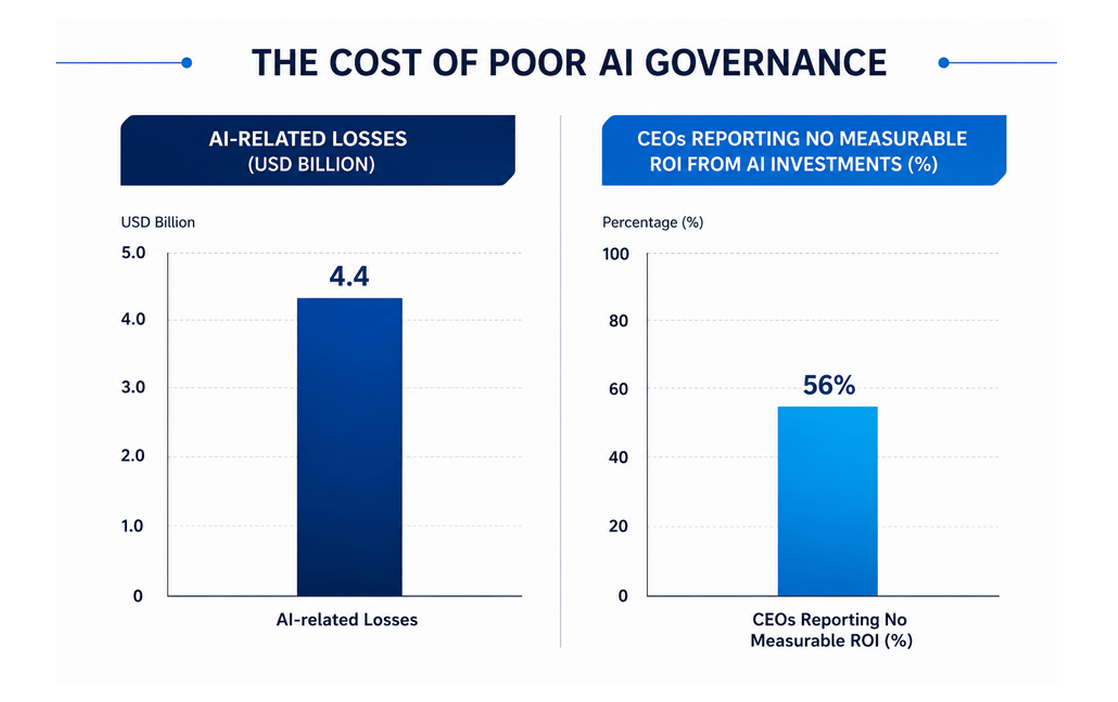
1.2 The Cost of Inaction

AI-related failures are already material:

  • Global enterprises reported $4.4 billion in AI-related losses due to bias, compliance failures, and system errors (Reuters)

  • 56% of CEOs report no measurable ROI from AI investments yet due to poor governance alignment (Business Insider)

The New Risk Landscape for Board Executives

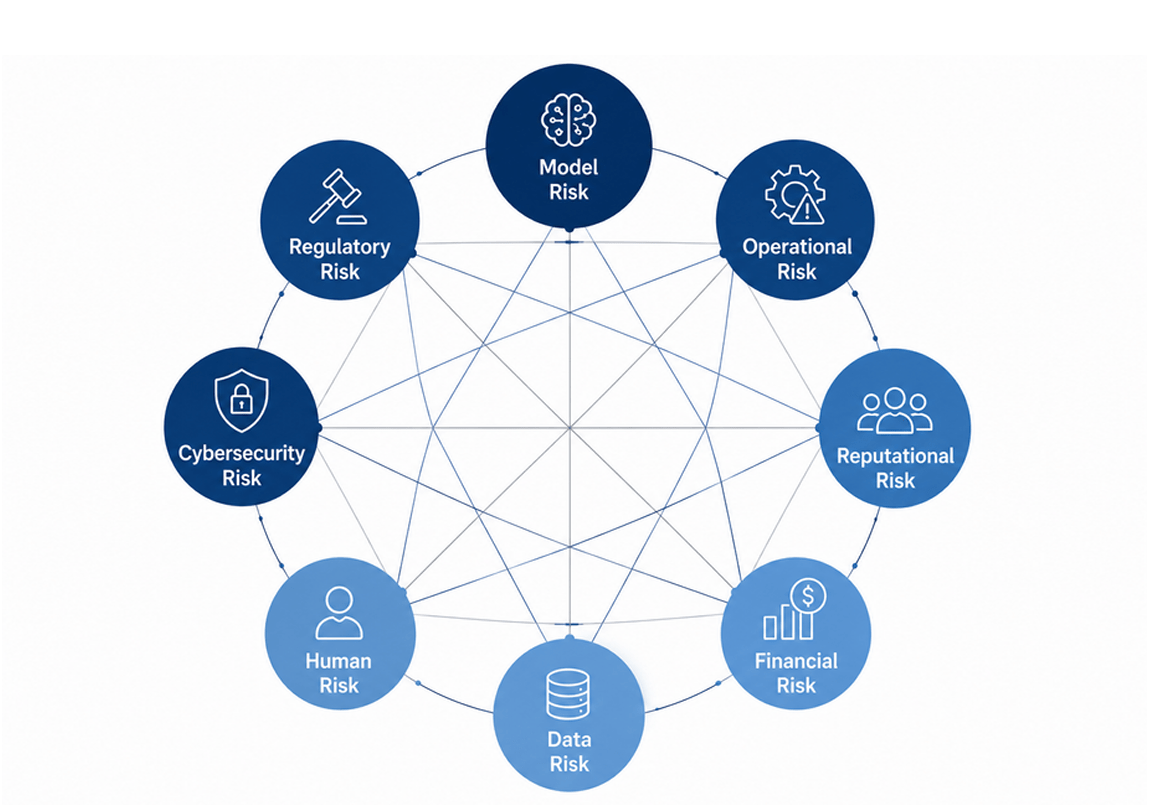
2.1 Emerging AI Risk Categories

Boards must oversee new risk classes:

  1. Model Risk
    • Incorrect outputs
    • Bias and discrimination
  2. Operational Risk
    • Automation errors
    • System dependencies
  3. Regulatory Risk
    • Upcoming frameworks like EU AI Act (2026)
  4. Reputational Risk
    • Public trust erosion
  5. Shadow AI Risk
    • Uncontrolled AI usage across teams
    • Amplifies human error risks
2.2 Interconnected Risk Ecosystem
AI risks are:
  • Non-linear
  • Interdependent
  • Rapidly evolving

Why Traditional Board Oversight Fails

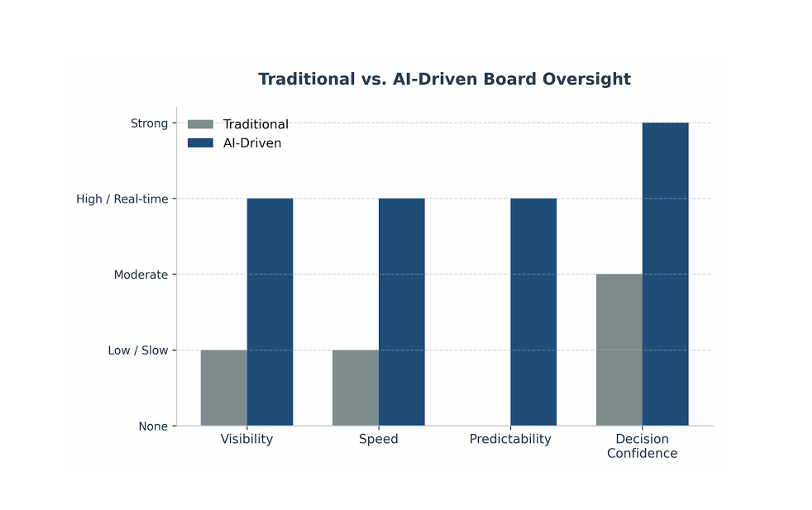
Traditional Board Oversight AI-Era Reality Governance Limitation
Quarterly reporting cycles Real-time risk shifts and emerging threats Delayed visibility and slower response to critical risks
Static dashboards and historical reporting Dynamic, continuously changing intelligence Decisions based on outdated information
Siloed risk, compliance, and operational functions Integrated and interconnected risk ecosystems Limited enterprise-wide visibility
Lagging indicators and retrospective analysis Predictive signals and forward-looking insights Inability to anticipate emerging risks
Periodic reviews and assessments Continuous monitoring and risk evaluation Reactive rather than proactive oversight
Manual data consolidation and reporting Automated analytics and intelligence-driven insights Reduced efficiency and increased reporting burden

AI-Driven Risk Management for the Board

4.1 Definition (Board Context)
The ability to continuously monitor, analyze, and predict enterprise risks using AI-powered intelligence—delivered in a format that supports board-level decisions.
4.2 Core Capabilities for Boards

1. Real-Time Risk Visibility

Boards gain:

  • Live dashboards
  • Risk heatmaps

2. Predictive Risk Insights

AI enables:

  • Scenario modeling
  • Early warnings
3. Enterprise-Wide Risk Integration
Single view across:
  • Risk
  • Compliance
  • Controls
4. Decision Intelligence
From:
  • Data → Insights → Action

The AI Governance Gap in the Boardroom

5.1 Structural Weaknesses

  • Only 28% of organizations define AI governance roles clearly (Knostic)
  • Only 13% ensure human oversight of AI systems (Trust.org)
5.2 Board-Level Challenges
Lack of AI Literacy

Directors lack technical understanding

Lack of Data Visibility

Fragmented reporting

Lack of Accountability

Unclear ownership

Strategic Role of AI in Board Decision-Making

  • AI is becoming a “cognitive layer” for executives:
  • Enhances scenario planning
  • Improves forecasting accuracy
  • Enables data-driven strategy
Research highlights AI as a “strategic moat” for competitive advantage (Researchgate)
Paradigm Shift in Executive Decision-Making
The integration of Artificial Intelligence as a foundational cognitive layer fundamentally re-architects C-suite decision velocity and strategic efficacy. By converting disparate, multi-structured datasets into high fidelity simulations, AI empowers leadership to execute advanced scenario planning and mitigate systemic volatility with unprecedented forecasting precision. This data-driven paradigm effectively eliminates speculative inertia, replacing institutional intuition with empirical validation. Consequently, organizations that successfully embed these predictive capabilities into their core operational architecture establish a defensible strategic moat—a sustainable competitive advantage that drives asymmetrical market leverage and renders traditional legacy frameworks obsolete.

SysRisk + AIRA: Board-Level Risk Intelligence

SysRisk (Governance Layer)

  • Enterprise risk register
  • Compliance integration
  • Governance workflows
  • Board-ready dashboards
AIRA (AI Intelligence Layer)
  • Predictive analytics
  • Pattern detection
  • NLP insights
  • Risk forecasting
Board-Level Outcomes
  • Single source of truth
  • Real-time oversight
  • Predictive governance
  • Faster decision cycles

Implementation Roadmap for Boards

Phase 1 - Awareness

  • Build AI literacy at board level

Phase 2 - Governance Framework

  • Define policies
  • Assign ownership

Phase 3 - Platform Adoption

  • Implement SysRisk

Phase 4 - AI Integration

  • Deploy AIRA

Phase 5 - Continuous Oversight

  • Real-time dashboards
  • Predictive insights

Best Practices for Board Executives

  • Treat AI as a strategic risk, not a technical tool
  • Establish AI governance committees
  • Demand real-time risk visibility
  • Align AI with enterprise risk strategy
  • Combine AI insights with human judgment

Mitigating Cognitive Vulnerability

As Artificial Intelligence transitions from a tactical utility to a core operational dependency, executive leadership must reframe the technology as a systemic enterprise risk rather than a isolated technical tool. Managing this frontier requires the immediate deployment of dedicated AI governance committees to oversee algorithmic integrity and compliance. Leaders must demand real-time risk visibility through dynamic dashboards to preemptively detect bias, drift, or data vulnerabilities. By fully aligning AI deployment with the overarching enterprise risk management (ERM) strategy, organizations safeguard their operational resilience. Ultimately, maximum strategic efficacy is achieved not through total automation, but by synthesizing high-velocity AI insights with seasoned human judgment to ensure ethical oversight and nuanced decision-making.

The Future of AI Governance in the Boardroom

AI will redefine governance:

  • AI-assisted board decisions
  • Real-time enterprise dashboards
  • Predictive governance systems
  • Autonomous risk monitoring
The Redefinition of Corporate Governance
The convergence of predictive analytics and executive oversight is fundamentally re-architecting corporate governance. Boardrooms are transitioning to AI-assisted decision-making, leveraging machine intelligence to synthesize complex variables for high-stakes fiduciary choices. This is operationalized via real-time enterprise dashboards that replace static quarterly reports with a continuous pulse of organizational health. Consequently, predictive governance systems shift leadership from a reactive to a proactive posture, preempting operational and regulatory friction. Anchoring this ecosystem are autonomous risk monitoring protocols that continuously scan internal workflows and market signals, establishing an always-on defensive perimeter that mitigates risk in lockstep with business velocity.

Conclusion

AI is fundamentally reshaping enterprise risk, but without boardlevel transformation it can increase complexity and unintended exposure rather than deliver control and value. Traditional governance models built on periodic reporting and static dashboards are increasingly misaligned with today’s fast-moving, interconnected risk landscape, leaving leadership with delayed visibility and reactive decision-making.
The future of governance will depend on intelligent oversight that combines AI-driven insights with human judgment. Continuous risk monitoring will replace static reporting, enabling real-time visibility across enterprise risk domains, while predictive decision-making will help leaders anticipate emerging risks, model outcomes, and respond proactively to strengthen resilience and long-term enterprise value.
Ready to elevate board oversight from periodic reporting to realtime risk intelligence?
SysRisk delivers enterprise-wide governance visibility, while AIRA empowers boards with AIdriven insights for faster, smarter, and more confident decisions.

Related Articles

Want to learn more about our ideas and thought leadership, please read the following. If there are any areas of interest from your organization, please feel free to reach out to us.