The Risk Register as the Foundation of ERM

The Risk Register as the
Foundation of ERM

www.sysonex.com

Table of Contents

Executive Summary

In today’s environment of accelerating change, regulatory pressure, digital disruption, and geopolitical uncertainty, organizations can no longer afford fragmented or informal approaches to managing risk. Leadership teams require a structured, transparent, and reliable view of the risks that could influence strategy, performance, reputation, and long-term sustainability. The risk register sits at the core of this capability. When designed and used effectively, it becomes far more than a documentation artifact—it becomes the operational foundation of Enterprise Risk Management (ERM), enabling clarity, accountability, and informed decision-making across the organization.
This whitepaper explores the strategic importance of the risk register, the essential components that define a high-quality register, the common weaknesses that undermine its effectiveness, and how organizations can modernize their approach using technology. It is intended to help leaders move beyond compliance-driven risk documentation toward a more intelligent, dynamic, and value-driven risk management capability.

Target Audience

This whitepaper is designed for:

  • Board Members and Executive Leadership
  • Chief Risk Officers (CROs)
  • CISOs and Compliance Leaders
  • Internal Audit Professionals
  • Governance, Risk, and Compliance (GRC) Teams
  • Business Unit Leaders responsible for risk ownership

Key Takeaways

  • Why the risk register is the foundation of ERM maturity
  • Core components of an effective risk register
  • Common mistakes that weaken risk visibility
  • How to structure a risk register for board-level reporting
  • How technology transforms static registers into dynamic intelligence

Introduction to the Risk Register

A risk register is a centralized repository that documents an organization’s key risks, their potential impact,
likelihood, ownership, and mitigation actions.

Unlike informal risk lists, a structured risk register enables organizations to:

  • Create visibility across departments
  • Establish accountability for risk ownership
  • Business Footprint
  • Support strategic decision-making
  • Enable consistent reporting to leadership and
    boards

Without a strong risk register, ERM efforts often become fragmented, inconsistent, and reactive.

Why the Risk Register Matters

- The Foundation of ERM
The risk register is not merely documentation—it is the operational engine behind ERM. It connects risk identification, assessment, response, and monitoring into a cohesive system.
- Supporting Strategic Oversight
Well-designed risk registers allow leadership teams to quickly understand:
  • Which risks threaten strategic objectives
  • Where controls are weak
  • Business Footprint
  • Which risks are escalating
  • Where management attention is required
- Strengthening Governance and Accountability

Assigning ownership to each risk reinforces accountability and ensures risks are actively managed— not passively recorded.

Core Components of an Effective Risk Register

A strong risk register typically includes:

  • Risk Title & Description – Clear, concise articulation of the risk
  • Risk Category – Strategic, Operational, Financial, Compliance, Technology, etc.
  • Root Cause – What drives the risk
  • Impact Assessment – Potential consequence on objectives.
  • Likelihood Assessment – Probability of occurrence
  • Inherent Risk Rating – Risk level before controls
  • Existing Controls – Current mitigation measures
  • Residual Risk Rating – Risk remaining after controls
  • Risk Owner – Individual accountable for management
  • Action Plans – Planned improvements or treatments
  • Status & Review Dates – Ongoing monitoring indicators

Common Pitfalls in Risk Registers

Many organizations struggle with risk registers because of:

  • Treating the register as a compliance exercise rather
    than a management tool
  • Overloading it with too many low-value risks
  • Writing risks too vaguely (e.g., “Operational risk exists”)
  • Failing to assign clear ownership
  • Leaving registers static and outdated
  • Using disconnected spreadsheets across departments
These issues reduce trust in risk data and weaken executive engagement.

Designing a Board-Ready Risk Register

To support leadership and governance, risk registers should:
  • Align risks directly to strategic objectives
  • Focus on material risks, not everything imaginable
  • Provide clear prioritization through risk scoring
  • Highlight top enterprise risks (Top 10–20)
  • Show trends over time (improving or deteriorating)
  • Enable quick visibility into accountability and
    actions
A board-ready risk register supports informed oversight, not administrative burden.

From Static Document to Living System

Historically, many risk registers have existed as spreadsheets updated once or twice per year. This approach is increasingly misaligned with the pace of modern risk environments.
Mature organizations now view the risk register as a living system, continuously informed by operational data, emerging trends, and leadership insight. Instead of simply recording risks, they use the register to actively:
  • Track changes in risk exposure
  • Monitor the effectiveness of controls
  • Escalate emerging issues quickly
  • Support real-time management discussions
  • Strengthen organizational awareness of risk
This evolution marks the difference between organizations that merely document risk and those that actively govern it.

The Role of Technology in Modern Risk Registers

Technology has become a critical enabler of effective risk register management. Digital platforms eliminate many of the limitations associated with manual tools by offering.
  • Centralized, organization-wide risk repositories
  • Consistent methodologies and scoring models
  • Automated workflows for reviews and approvals
  • Real-time dashboards for leadership visibility
  • Audit trails that support governance and regulatory expectations
  • Advanced analytics that highlight patterns and emerging exposures
Increasingly, organizations are also exploring the use of artificial intelligence to enhance risk identification, improve data quality, and provide predictive insights—further transforming the risk register into a strategic intelligence asset.

Best Practices for Sustainable Risk Register Management

Organizations that demonstrate strong risk maturity tend to treat the risk register not as a document, but as a discipline. Common practices include:
  • Embedding risk reviews into existing management rhythms
  • Regularly challenging and refining risk statements for quality
  • Automated workflows for reviews and approvals
  • Ensuring senior leaders actively engage with top risks
  • Training risk owners to improve consistency and clarity
  • Linking risks to performance, controls, and decision- making
  • Reinforcing the message that the register exists to support better outcomes, not compliance

Sustainability is achieved when risk registers become part
of how the organization thinks, not just how it reports.

Conclusion

The strength of an organization’s risk register reflects the maturity of its risk management capability. Weak or fragmented registers limit visibility and accountability, while well-designed registers enable transparency, stronger governance, and better strategic decisions. As risk environments become more complex, organizations must move beyond static documentation toward dynamic, leadership-oriented risk registers that actively support oversight and resilience.
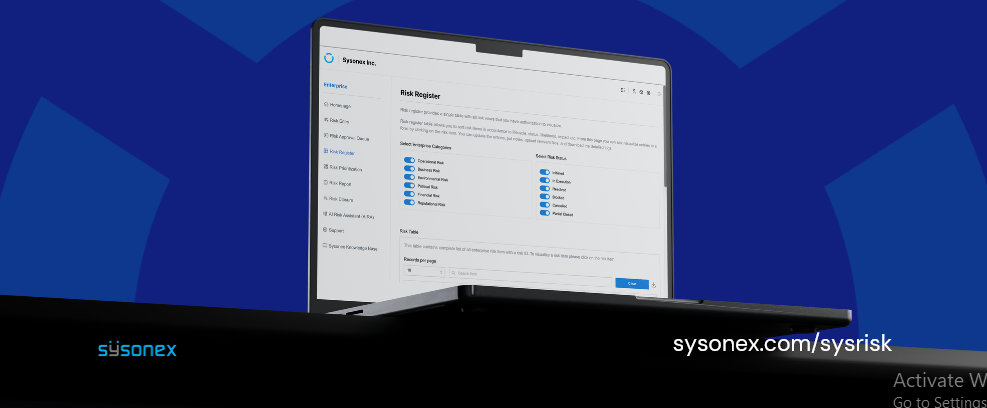
By standardizing risk identification, assessment, ownership, and monitoring, SysRisk delivers real-time visibility into enterprise risks and supports board-ready reporting. Its structured workflows, consistent scoring, and continuous monitoring capabilities enable organizations to prioritize what matters most, strengthen accountability, and align risk management with strategic objectives— turning the risk register into a true engine of enterprise resilience.

Related Articles

Want to learn more about our ideas and thought leadership, please read the following. If there are any areas of interest from your organization, please feel free to reach out to us. 

Your form has been successfully submitted. Go to the next step to get a free Sysrisk user license.