AI-Driven Enterprise Risk Management

AI-driven enterprise risk management

Transforming Enterprise Risk Management through Artificial Intelligence, Predictive Intelligence, and Continuous Risk Visibility

www.sysonex.com

Sysonex, Risk Management

Table of Contents

Executive Summary

From Compliance Function to Strategic Intelligence
Enterprise Risk Management has evolved from a compliance-driven function into a strategic capability that enables organizations to anticipate uncertainty, protect enterprise value, and support informed decision-making.

“Rather than simply recording risks, AI enables organizations to understand risk relationships, predict emerging threats,
and provide leadership with actionable intelligence in real time.”

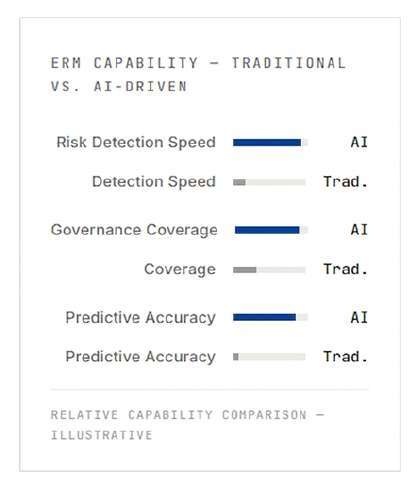
Traditional ERM approaches — built around periodic assessments, fragmented data, and manual reporting — are increasingly unable to keep pace with today’s rapidly changing risk landscape. The gap between risk velocity and organizational response capability has never been wider.
Artificial Intelligence is fundamentally reshaping ERM by introducing automation, predictive analytics, natural language processing, and continuous monitoring into every stage of the risk lifecycle.

The Evolution of Enterprise Risk Management

How ERM Has Transformed
ERM has undergone a significant transformation over the past two decades — from managing financial and operational risks through periodic reviews to addressing cyber threats, geopolitical uncertainty, climate risks, regulatory complexity, AI governance, and operational resilience simultaneously.
Today’s enterprise risks are interconnected, dynamic, and often emerge simultaneously across multiple business functions. Organizations therefore require an ERM approach that is enterprise-wide, continuous, data-driven, predictive, and intelligence-enabled.
5x
Faster risk emergence velocity vs. a decade ago
Industry Benchmark
72%
of S&P 500 companies disclosed AI related risks in 2025
SEC Filings Analysis
97%
of AI breach incidents involve weak access controls
Cybersecurity Report
€35M
maximum penalty per violation under EU AI Act 2026
EU Regulatory Body

Why Traditional ERM Is No Longer Enough

Structural Limitations of Conventional Frameworks
Traditional ERM frameworks suffer from structural limitations that prevent leadership from responding quickly to emerging risks. As organizations become increasingly digital, these approaches create visibility gaps that can be catastrophic.
Dimension Modern AI-Driven Reality
Annual or quarterly risk assessments Continuous, real-time risk sensing
Spreadsheet-driven risk registers Intelligent, self-updating risk platforms
Manual reporting with significant lag Automated, real-time executive reporting
Siloed business functions Integrated enterprise-wide risk ecosystems
Limited predictive capabilities AI-powered predictive risk modeling
Delayed executive reporting Instant board-level intelligence dashboards

AI as the Foundation of Modern ERM

Augmenting Human Expertise with Machine Intelligence
Artificial Intelligence enhances every component of enterprise risk management by augmenting — not replacing — human expertise. Five core capabilities define the AI-enhanced ERM function.
01

Intelligent Risk Identification

AI continuously analyzes structured and unstructured enterprise data — transactions, logs, communications, external signals — to identify new and emerging risks that human analysts would miss at scale or speed.

02

Predictive Analytics

AI continuously analyzes structured and unstructured enterprise data — transactions, logs, communications, external signals — to identify new and emerging risks that human analysts would miss at scale or speed.

03

Natural Language Processing

AI extracts risk signals from policies, regulations, audit reports, contracts, incident reports, and news sources — synthesizing information from across the enterprise into coherent risk intelligence.

04

Continuous Monitoring

Instead of periodic assessments, AI continuously evaluates risk indicators across the enterprise — eliminating the dangerous blind spots that exist between quarterly review cycles.

05

Intelligent Decision Support

Executives receive contextual recommendations supported by enterprise-wide data — transforming risk reporting from backward-looking summaries into forward-looking strategic intelligence.

The AI-Driven ERM Framework

A Continuous Intelligence Loop, Not a Linear Process
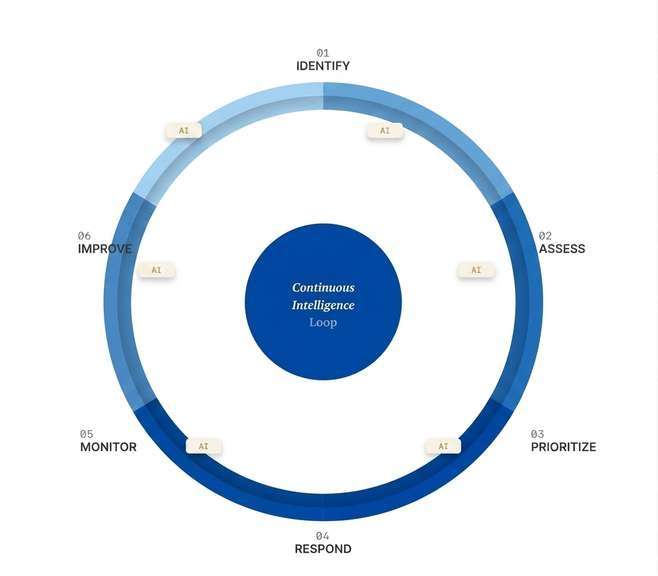
The AI-Driven ERM Framework introduces a six-stage model — but unlike traditional linear approaches, AI enables these activities to function as a continuous, self-reinforcing intelligence loop.
AI is embedded at every stage of the loop — enabling continuous, self-reinforcing risk intelligence rather than isolated periodic assessments.

AI Across the Enterprise Risk Lifecycle

Intelligence Across Every Risk Domain
AI does not operate in one corner of ERM — it flows across every risk domain, enabling intelligence to move between functions rather than remaining siloed within them.
01

RISK REGISTER

  • Auto-update and classification
  • Intelligent prioritization
  • Cross-risk correlation
02
RCSA
  • AI-assisted scoring
  • Pattern detection
  • Insight generation
03

RCSA

  • Regulatory tracking
  • Gap detection
  • Auto-obligation mapping
04
INTERNAL AUDIT
  • Risk-based planning
  • Automated testing
  • Finding classification
05
THIRD-PARTY RISK
  • Vendor risk scoring
  • Continuous monitoring
  • Concentration analysis
06
OPERATIONAL RISK
  • Process anomaly detection
  • Loss forecasting
  • Control effectiveness
07
CYBER RISK
  • Threat signal analysis
  • Attack path prediction
  • Security posture scoring
08
ESG RISK
  • Sustainability risk signals
  • Regulatory alignment
  • Reporting automation
09
BUSINESS CONTINUITY
  • Disruption forecasting
  • Recovery optimization
  • Scenario simulation
10
INCIDENT MANAGEMENT
  • Pattern recognition
  • Predictive alerting
  • Root cause analysis
Cross-functional intelligence: AI ensures that insights from one risk domain flow automatically to adjacent functions — compliance findings inform audit plans, incident patterns update risk registers, and third party risk signals surface in operational risk dashboards.

Enterprise Benefits of AI-Driven ERM

Quantified Returns from Intelligent Risk Management
Artificial Intelligence is redefining Enterprise Risk Management by transforming it from a reactive, process-driven function into a proactive, intelligence-led capability. By integrating AI across the ERM lifecycle, organizations gain deeper visibility into enterprise risks, improve the speed and quality of decision-making, strengthen governance, and enhance overall organizational resilience. The following are the key benefits of adopting an AI-driven ERM framework.
7.1 Better Risk Visibility
Traditional ERM often relies on fragmented data sources, departmental reports, and periodic assessments, making it difficult to obtain a complete view of enterprise risk. AI consolidates risk data from multiple business functions into a centralized platform, providing leadership with a real-time, enterprise-wide view of the organization’s risk landscape. Interactive dashboards, dynamic risk heatmaps, and AI-powered analytics enable executives to identify emerging trends, monitor key risk indicators (KRIs), and understand relationships between interconnected risks. This holistic visibility supports more informed strategic planning and ensures that critical risks are identified before they escalate.
7.2 Faster Decision-Making
In today’s rapidly evolving business environment, timely decisions are essential to maintaining resilience and competitive advantage. AI significantly accelerates the risk management process by automating data collection, analysis, and reporting. Instead of waiting for monthly or quarterly reports, executives receive continuous updates supported by predictive analytics and intelligent alerts. This enables leadership to evaluate changing risk conditions, prioritize responses, and make data driven decisions with greater speed and confidence, reducing the time between risk identification and corrective action.
7.3 Stronger Governance
Consistent governance is fundamental to effective Enterprise Risk Management. AI-driven ERM helps standardize risk assessment methodologies, scoring models, and reporting practices across the organization, reducing inconsistencies caused by manual processes. Automated workflows improve accountability by ensuring that risk owners, reviewers, and executives follow structured governance procedures. Centralized documentation, audit trails, and approval workflows further strengthen transparency, enabling organizations to demonstrate compliance while fostering a culture of accountability and responsible decision-making.
7.4 Improved Regulatory Compliance
The regulatory environment continues to evolve, requiring organizations to monitor changing requirements across multiple jurisdictions. AI enhances compliance by continuously monitoring regulatory updates, mapping obligations to enterprise risks and controls, and identifying potential compliance gaps before they become significant issues. Automated notifications, policy tracking, and real-time compliance dashboards enable organizations to respond more quickly to regulatory changes while maintaining comprehensive documentation for audits and regulatory reviews. This continuous approach reduces compliance risk and improves overall governance effectiveness.

7.5 Higher Operational Resilience

Organizations face increasingly complex operational risks arising from cybersecurity threats, supply chain disruptions, technology failures, and changing market conditions. AI strengthens operational resilience by continuously analyzing internal and external data to detect anomalies, identify early warning signals, and forecast potential disruptions. Predictive analytics enables organizations to anticipate emerging threats and implement mitigation strategies before incidents significantly impact business operations. This proactive capability minimizes operational downtime, protects critical business functions, and improves the organization’s ability to adapt to uncertainty. 8.6 Better Resource Allocation

Challenges and Considerations

Implementation Barriers and How to Address Them
While AI offers significant advantages for Enterprise Risk Management, successful implementation requires overcoming several organizational and technical challenges. Addressing these barriers is essential to ensure AI delivers reliable, transparent, and sustainable outcomes.
Poor Data Quality
AI depends on accurate, complete, and consistent data. Poor-quality data can lead to unreliable insights and ineffective risk decisions.
Fragmented Systems
Disconnected platforms and siloed information limit AI’s ability to provide a unified view of enterprise risk.
Lack of AI Governance

Disconnected platforms and siloed information limit AI’s ability to provide a unified view of enterprise risk.

Skills Shortages
Organizations need professionals with expertise in AI, data analytics, and risk management to maximize AI’s value.
Organizational Resistance
Adopting AI often requires cultural change, process redesign, and stakeholder buy-in to ensure successful implementation.
Explainability of AI Models
AI-driven decisions should be transparent and understandable to build trust among executives, regulators, and stakeholders.
Ethical Considerations
Organizations must ensure AI is used responsibly by addressing bias, fairness, privacy, and accountability throughout the risk management process.
The Importance of Governance
AI adoption should always be supported by a strong governance framework. Establishing clear policies, accountability, human oversight, and continuous monitoring ensures AI remains aligned with business objectives, regulatory requirements, and ethical standards while delivering trusted, enterprise-wide risk intelligence.

Strategic Role of AI in Board Decision-Making

One Platform for Intelligent, Enterprise-Wide Risk Management
SysRisk, powered by AIRA, delivers a unified enterprise intelligence platform — combining structured governance infrastructure with AI driven analytics to transform every stage of the risk lifecycle.

Board Decisions

Strategic oversight · Predictive governance · Regulatory confidence · Real-time intelligence

Executive Dashboards

Risk heatmaps · KRI monitoring · Compliance status · Scenario forecasts · Board packs

SysRisk Platform

Risk Register · Compliance · RCSA · Control Library · KRIs · Workflows · Audit · Third-Party Risk

Enterprise Data Sources

Systems · Transactions · Logs · External signals · Regulations · Audit findings · Incident reports

AIRA Intelligence Layer

Predictive analytics · NLP insights · Pattern recognition · AI recommendations · Generative summaries

Future Outlook — The Next Generation of Enterprise Risk Managementof AI Governance in the Boardroom

The Next Generation of Enterprise Risk Management
The future of Enterprise Risk Management is shifting from reactive oversight to intelligent, autonomous decision support. Emerging technologies such as Agentic AI, predictive governance, and digital twins will enable organizations to continuously monitor risks, simulate potential scenarios, and recommend optimal mitigation strategies. AI assisted board reporting, autonomous control testing, continuous regulatory intelligence, and AI-powered strategic planning will further strengthen governance and accelerate decision-making.
Rather than simply recording and reporting risks, next-generation ERM platforms will continuously anticipate emerging threats, generate actionable insights, and recommend timely responses. SysRisk, powered by AIRA, is designed to support this evolution—helping organizations build a more intelligent, proactive, and resilient ERM framework for the future.

Conclusion

Enterprise Risk Management is entering a new era where intelligence, speed, and continuous visibility define organizational resilience. As risks become increasingly interconnected and fast moving, traditional ERM practices can no longer provide the agility or insight required to support strategic decision-making.
SysRisk, powered by AIRA, enables this transformation by bringing together governance, risk, compliance, and AI-driven intelligence on a single platform. With centralized visibility, intelligent automation, and real-time insights, organizations can build a resilient, future-ready ERM framework that supports sustainable growth, regulatory confidence, and long-term enterprise success.
Ready to transform Enterprise Risk Management into continuous enterprise intelligence?
SysRisk provides the enterprise platform for structured ERM, while AIRA enhances every stage of the risk lifecycle with AI-powered insights, predictive analytics, and real-time visibility— empowering organizations to manage uncertainty with confidence.

Related Articles

Want to learn more about our ideas and thought leadership, please read the following. If there are any areas of interest from your organization, please feel free to reach out to us.